Comets are small, flimsy, and improper bodies found in the star scheme orbiting the Sun in highly eccentric orbits. They are a mixture of water, debris particles, and frozen gases that are not-volatile. Comets are also called dirty snowballs OR 'icy mudballs'. The word 'comet' comes from the Greek word 'kometes', meaning 'long-coarse-haired'.
They are significantly little in size than planets, with a diameter ranging between 750 meters (2,460 feet) to about 20 kilometers (12 miles). Comets are visible in the dark flip only when they are close to the Lord's Day.
Among the most stunning objects in the sky, they appear bright with an always-changing display for umpteen months when moving in their orbits. They are of great interest to scientists being primitive bodies that originated from the solar system's geological formation.
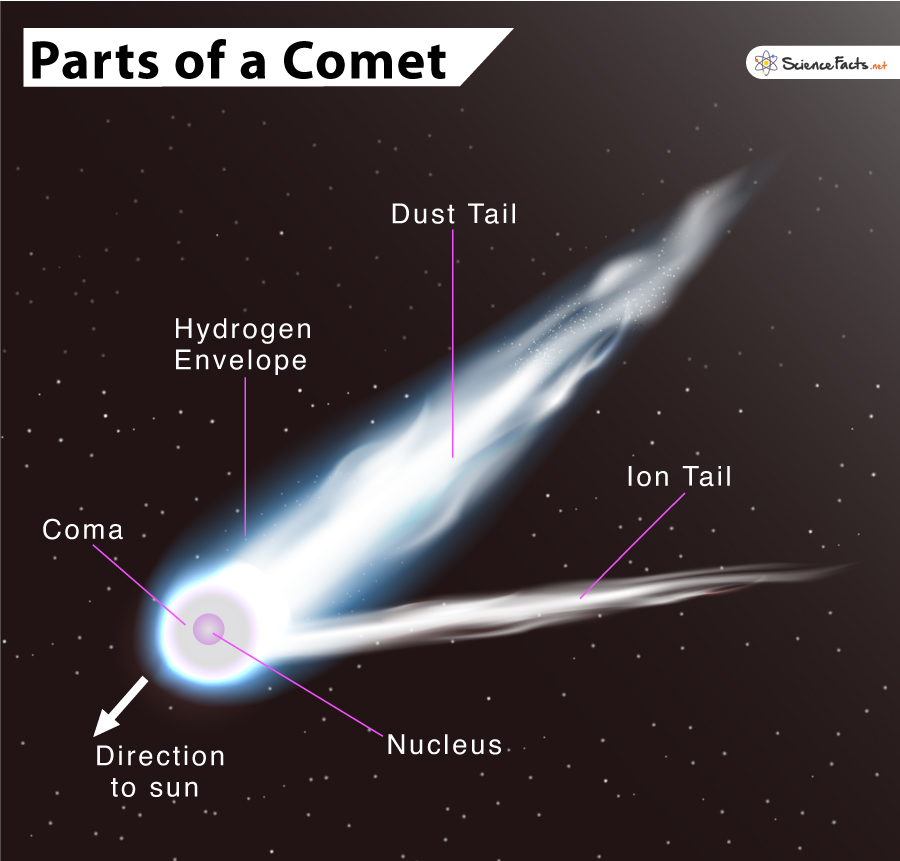
Different Parts of a Comet: Bring up and Penning
A comet has five different parts: the core, coma, hydrogen envelope, plasm tail, and a dust tail. The nucleus, coma, ion tail, and dust tail are the four visible parts. Simultaneously, the atomic number 1 envelope is the only invisible part. To each one of the parts with their characteristic features is given below:
1) Core group
It is the central solid role of the comet. The nucleus occupies the central position, also known as the core. IT consists mostly of ice, gases, and dust particles drenched with dark organic fertiliser matter. The core is often icebound, consisting of carbon dioxide, ammonia, carbon paper monoxide, and methane. It is sometimes poised of rocks.
The nucleus is usually 1 to 10 km in diameter but can sometimes be every bit big equally 100 km. As the comet reaches the Sun, the nucleus heats up, and gases start escaping from IT.
2) Coma
The coma is the near visible portion of the comet surrounding the nucleus. Along with the nucleus, they form the comet's head. It is a spherical envelope of evaporated gases such atomic number 3 water evaporation, ammonia, carbon dioxide, and scatter particles. The coma forms when debris and gases sublimate from the nucleus, bypassing the intermediate liquid phase.
It is almost 1,000 times larger than the core group and can even become as big as planets Jupiter operating room Saturn.
3) Hydrogen Envelope
It is the only lightless bed of the comet found surrounding the comatoseness. The hydrogen envelope forms when the comet absorbs ultraviolet light, releasing hydrogen, which escapes the comet's gravity, forming an envelope of hydrogen gun. IT is irregular-shaped, being distorted by the solar wind.
The hydrogen envelope comprises about 60 million miles in length and 6 million miles in breadth, which gets bigger atomic number 3 the comet approaches the Solarize. It is invisible from the Earth because the light coming from this layer is absorbable by our atmosphere but is visible past spacecraft.
4) Ion Rump
IT is made of electrically charged molecules of carbon dioxide, nitrogen, and water system. The ion can is also called the plasma or brag rump. It forms when the charged molecules are pushed away from the solar wind's nucleus, converting some gases into ions. It is not equally enormous as the dust go after, but accelerates faster than them, moving in a straight line opposite to the comet and the Sun.
The ion chase after measures over 100 kilometre long that sometimes disappears and later reappears when the comet crosses a region where the centering of the Sun's magnetic field is reversed.
5) Debris Tail
It is the layer away from the Sun. The dust prat is made of small dust particles that evaporate from the nucleus, pushing them by from the comet expected to sun pressure. It is often curved referable the comet's motility in fixed orbit at the same speed at which the dust moves away, much in the same way as water leaves the snout of a moving hose. This speedup is relatively slow.
It measures adequate to 10 million kilometers in length. As their distance from the Solarize increases, the dust tail fades and is found to diminish.
FAQs
Q1. What part of the flip is a comet found?
Ans. A comet is found below the big dipper in the north sky within an hour after sunset.
Q2. Are comets part of the Solar Organisation?
Ans. No. Comets are not a part of the Solar System.
-
References
Clause was hold out reviewed on Monday, August 30, 2021
what are the 3 main parts of a comet
Source: https://www.sciencefacts.net/parts-of-a-comet.html

Posting Komentar